It is a fact that leaves visitors incredulous: this peaceful sub-prefecture of the Loiret is one of the cradles of contemporary China. Coachloads of Chinese visitors come every year to photograph its bronze plaques, and Montargis was even nicknamed for a while “from Venice to Shanghai”. Here is why.
The Work-Study movement
At the turn of the 1910s–20s, the young Republic of China sought to train a generation of modern cadres. The Work-Study movement (“a year of work, a year of study”) sent thousands of young Chinese to France: by day they worked in factories; in the evenings and between contracts they studied French, science… and the political ideas circulating in post-war Europe.
The Gâtinais became one of the movement's great centres: an estimated several hundred of these worker-students — around three hundred — passed through Montargis and its surroundings, employed notably at the Hutchinson factory in Châlette-sur-Loing, at the town's edge, where rubber shoes were made.
A teenager named Deng Xiaoping
Among them, a round-faced young Sichuanese who arrived in France at 16: Deng Xiaoping. In 1922 he joined the Hutchinson factory, where his employment card is still kept — with the note made famous after his second stint: “refused to work, do not rehire”. Here the teenager discovered the working condition, activism and the circles of Chinese youth in France, alongside figures like Zhou Enlai, the future premier, who also frequented the area.
Half a century later, the worker of Châlette, become China's paramount leader, would launch the reforms that transformed China — and the world.
Other Gâtinais boarders would become ministers, generals or major intellectuals of 20th-century China. For Chinese historians, Montargis is quite simply a birthplace of the modern Chinese project.
The Chinese trail: history in the open air
The town has waymarked a memorial route, the Chinese trail: a walk lined with bilingual bronze plaques linking the places where the worker-students lived, studied and met — school, hostels, squares, canal banks. Allow an hour's walk; map available at the tourist office. An unexpected and moving way to rediscover the town.
The museum of Franco-Chinese friendship
Housed on rue Raymond-Tellier, in the former hostel where the Chinese students lodged, the historical museum of Franco-Chinese friendship gathers photographs, documents and objects of the Work-Study movement. Small in size, great in subject — and regularly visited by delegations from China, proof that the story is anything but anecdotal.
In Beijing as in Chengdu, “Montargis” rings a bell for many educated Chinese — often more than for many French people. The station has even hosted official Franco-Chinese ceremonies.
In practice
- Chinese trail: free access, all year round. Start from the centre; map at the Agglomération Montargoise tourist office.
- Museum of Franco-Chinese friendship: check opening days before your visit (seasonal hours).
- Combine with: the canal circuit — the two walks overlap nicely. See all the must-sees.
Sleep where the story happened
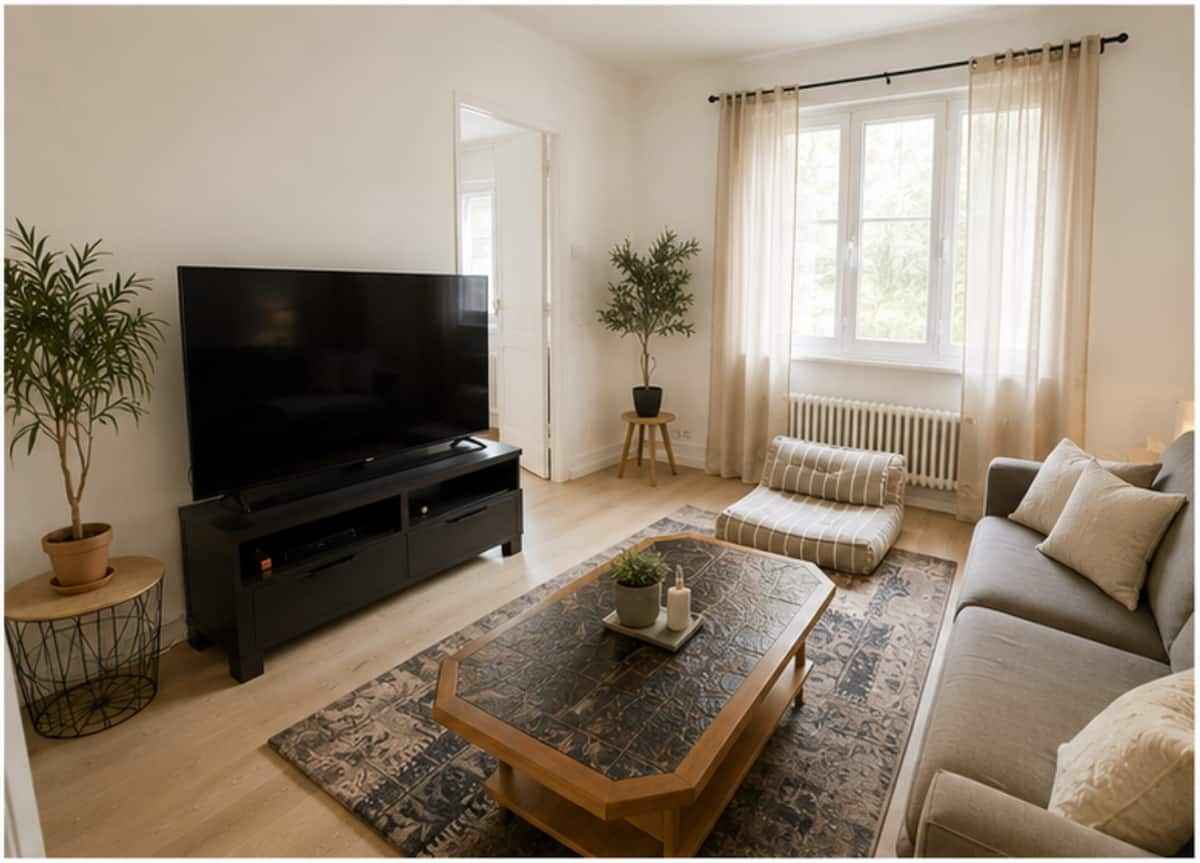
Central Montargis is made for exploring on foot — Chinese trail included. Our recommendation: a cosy 60 m² apartment between the station and the canals, with free parking, a shared garden and two bikes to ride out to Châlette-sur-Loing in the footsteps of the Hutchinson factory.
See the apartment on Airbnb